
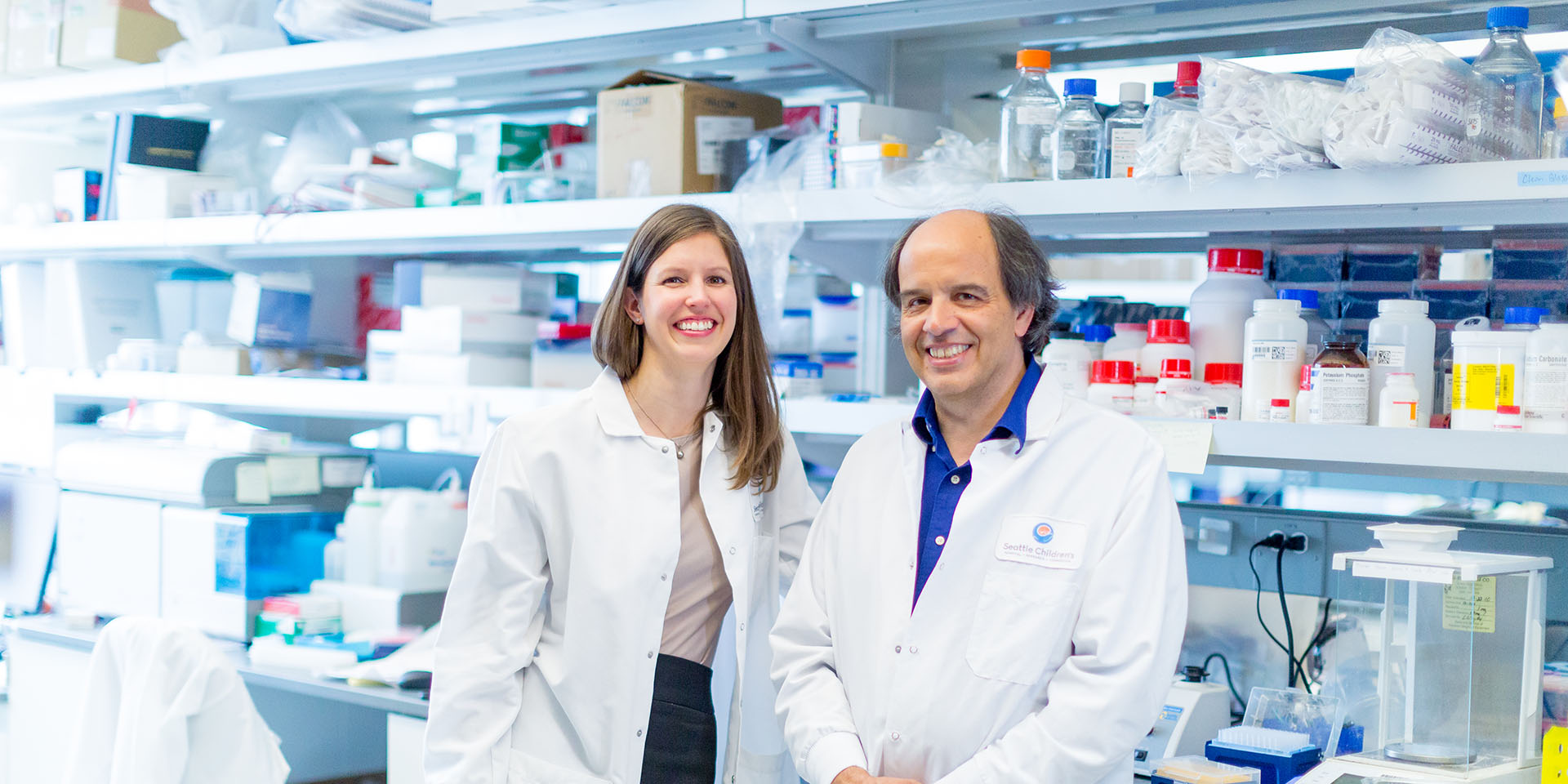
Ramirez Lab
The Ramirez Lab investigates brain functions in order to develop new ways to treat – and potentially cure – neurological disorders.
We are particularly interested in how neurons form into networks, and how those networks turn on and off to create rhythms that direct the brain – and the body – to perform different functions.
We take a collaborative approach to research, teaming up with experts in different disciplines – from genetics to biology to engineering – to study brain disorders and pursue cures.
Unraveling the mechanisms that control breathing
We discovered how the neuronal network that controls breathing reconfigures to generate sighs and gasps. Gasps in particular help animals and people take in air and survive when they’re starved of oxygen. Now we’re pinpointing the networks that control other aspects of breathing. This research is helping us understand sudden infant death syndrome (SIDS) and erratic breathing in children with Rett syndrome, epilepsy and other disorders.
Working to prevent SIDS and sudden deaths in general
The Ramirez lab has studied the causes leading to Sudden Infant Death Syndrome (SIDS) for more than two decades. Based on the concept that children die of SIDS because they fail to arouse in response to a hypoxic/hypercapnic stress, the Ramirez lab focused on unraveling the cellular mechanisms underlying the hypoxic response. This work led to many publications, and a deep understanding of the cellular and molecular mechanisms that reconfigure the respiratory network, and that activate an effective resuscitation response including characteristic changes in the heart rate and the activation of an arousal response.
In collaboration with their wonderful colleagues at Microsoft (AI for health) and Dr. Ed Mitchell (University of Auckland), the Ramirez lab has also explored the risk factors leading to SIDS. These epidemiological studies showed e.g. that children dying during the first 48 hours had different risk factors than those dying later suggesting that these deaths have different causes. Thus, the Ramirez lab now follows the hypothesis that the deaths occurring during the first 1-2 days after birth (SUEND, sudden unexpected neonatal death) are caused by the failure to transition from the uterus, where the baby is protected by the mother’s circulatory system, to air breathing, when the baby suddenly needs to rely on its own intact cardiorespiratory system. Multiple causes can be responsible for the failed transition including, disturbances in the development of lungs and heart as well as the central control of the cardiorespiratory network. Similarly, complex are the causes leading to SUID (sudden unexpected infant death), the deaths that occurs during the remainder of the first year. Aside of prone sleeping, smoking is another major and preventable risk factor for SUID, and every cigarette smoked during pregnancy increases the risk.
More recently the Ramirez lab began to pursue whole genome sequencing of tissue obtained from children that died of SIDS. They found that most potentially, pathogenic gene variants were associated with cardiac failure, sudden cardiac death and neurological disorders, in particular epilepsy. This finding was transformative as it suggests that many infants that died of SIDS had similar genetic vulnerabilities than children and adults dying later in life because of sudden cardiac death, sudden death of childhood (SUDC), sudden death of athletes or sudden death of epilepsy (SUDEP). The Ramirez lab continues whole genome sequencing of SIDS, but now expands their studies to also encompass SUDC, SUDEP and sudden cardiac death. The long-term goal is to develop postnatal sequencing to will early on diagnose children that are at risk to succumb to sudden death later in life. Given that more than 1000 people die of sudden death every day in the USA alone, the Ramirez lab believes that early diagnosis will lead to effective prevention strategies that will save many lives.
Studying how media use impacts brain development
We are teaming up with Dr. Dimitri Christakis and his lab to investigate how television and media impact brain development. Our initial research showed that too much media exposure can trigger attention problems in animal models.
Addressing attention and impulse control disorders
Tourette syndrome, attention deficit hyperactivity disorder (ADHD), obsessive-compulsive disorder and other conditions are united by a key thread: Affected children can’t control unwanted behaviors. We’re unraveling how the brain controls impulses and attention, and are studying promising therapies that correct these problems in animal models.
Understanding fatal seizures
We are collaborating with Dr. Franck Kalume and his lab to understand the causes of a fatal condition called sudden and unexpected death in epilepsy, and find ways to prevent it.
Targeting and understanding glioblastoma
The deep understanding of network function and the studies of neuroglial interactions motivated Dr. Ramirez to also study glioblastoma.
Halting schizophrenia progression
High levels of C4, a protein that is a key component of the body’s synaptic pruning pathway and helps to regulate connections between neurons, appear to be correlated with excessive synaptic pruning and the progression of schizophrenia. We have developed a Bispecific Complement Engaging Protein (BiCEP) that can bind to C4, remove it from circulation and mark it for degradation. We believe this novel therapeutic could be administered to patients who show early symptoms or higher risk of developing schizophrenia, to slow or halt the progression of the condition. We’re currently conducting proof-of-principle testing in preclinical models to generate preclinical data ahead of IND filing and future clinical trials.
Featured Research
Lab News
- August 31, 2025 Washington Research Foundation awards grant to Ramirez Lab to develop schizophrenia treatment
- April 9, 2025 Publication Q&A: Ndufs4 Inactivation in Glutamatergic Neurons Reveals Swallow-Breathing Discoordination in a Leigh Syndrome Model
- October 9, 2024 Ones to watch: young neuroscientists on the rise
See all news and publications.
Nino Ramirez
Jan-Marino (Nino) Ramirez, PhD, is director of the Center for Integrative Brain Research at Seattle Children’s Research Institute and a professor of neurological surgery at the University of Washington. His work is supported by multiple National Institutes of Health grants.